


Defining the CDU
A Cooling Distribution Unit (CDU) is an indispensable core component in liquid cooling systems. It is responsible for uniformly distributing the cooling medium to every heat dissipation point throughout the system. By regulating and controlling the flow and temperature of the cooling medium, the CDU ensures that all components operate stably within a safe temperature range.

The Role of a CDU in the System
The CDU works in coordination with internal pumps, heat exchangers, radiators, and controllers to form a complete cooling loop. Its primary functions include stabilizing the flow rate of the cooling medium and reducing the load on other components, which effectively enhances overall system performance and service life.
Key Industry Applications
- Data Centers & Cloud Computing: Driven by the rapid growth of AI, data centers are moving toward high-density and high-power architectures. For the latest GPUs (such as H100 and B200), traditional air cooling is no longer sufficient. In AI high-density server racks, the CDU acts as the heart of the liquid cooling system, efficiently transferring heat from the Secondary Loop (server side) to the Primary Loop (facility side). This significantly reduces Power Usage Effectiveness (PUE) and air conditioning loads in hyperscale data centers.
- Semiconductor Manufacturing & Testing: Temperature stability directly impacts product yield and process precision. CDUs provide high-precision temperature control for wafer processing (such as etching and developing) and Automated Test Equipment (ATE). This ensures data accuracy during the high-load testing of advanced chips.
- Supercomputers & High-Performance Computing (HPC): Systems used for climate simulation or gene sequencing require constant high-load operation and extreme heat dissipation. CDUs support Immersion Cooling by circulating cooling fluids between tanks and heat exchangers, and Direct-to-Chip cooling by removing heat directly from the processor via cold plates.
- Automotive Industry: CDUs are used in R&D for autonomous driving simulations, which require high-density server support. They also provide thermal management for battery and motor testing under extreme charging/discharging conditions to reduce thermal risks.
- Energy & Power Systems: In Energy Storage Systems (ESS), CDUs control lithium battery temperatures to prevent thermal runaway. They also provide cooling for high-power conversion equipment like inverters and variable frequency drives.
How Sealless Magnetic Drive Pumps Impact Performance
In a CDU system, the sealless magnetic drive pump is the power core driving the circulation. Its flow stability, corrosion resistance, and leak-proof design directly determine the reliability of the entire cooling system. Improper pump selection can lead to poor heat dissipation, coolant contamination, or equipment damage.
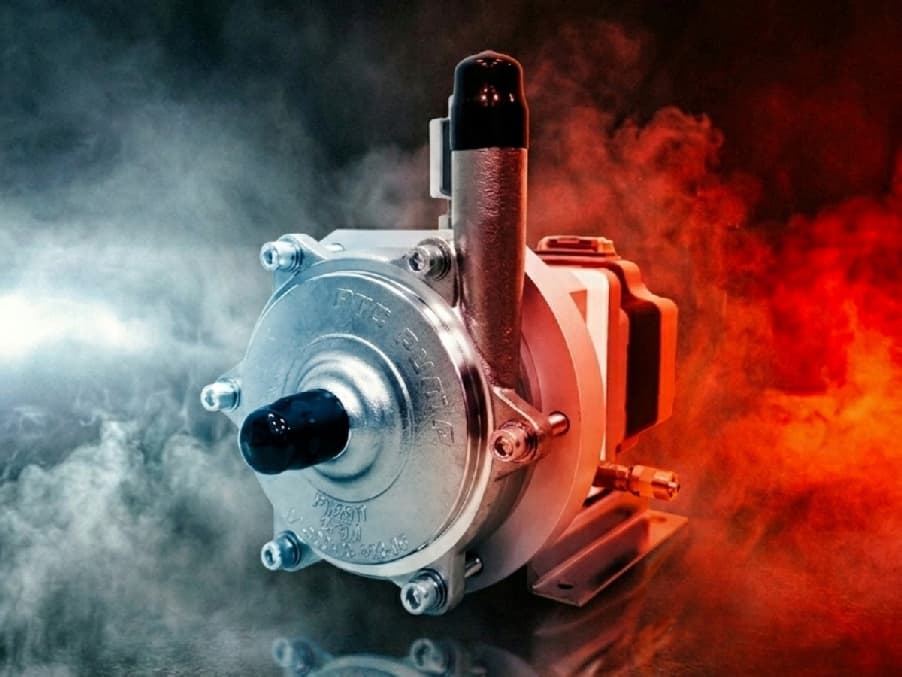
Solution Spotlight: Kong Hai Enterprise FPM Series Chemical Pumps feature a sealless magnetic drive design that is corrosion-resistant and leak-proof. With a compact, high-efficiency structure that reduces volume by 1/3 while increasing delivery capacity, they are a reliable choice for 24/7 high-load liquid cooling applications.
Key Technical Indicators for CDU Selection
When evaluating a CDU system, consider the following technical specifications:
- Cooling Capacity (kW): The maximum heat load the unit can carry.
- Coolant Flow Rate (LPM / GPM): The volume of liquid delivered per unit of time.
- Inlet / Outlet Temperature Difference: A direct indicator of heat exchange efficiency.
- Operating Pressure: Ensures the safety range for piping and pumps.
- Coolant Compatibility: Material matching for water-based fluids, fluorinated fluids, or other media.
- Monitoring & Sensors: Real-time tracking of flow, temperature, and pressure anomalies.

Conclusion: Precision Starts with the Details
While overall cooling data is important, the stability of internal components—especially the circulation pump—is the true core of ensuring uninterrupted AI computing.
Kong Hai Enterprise — Providing the Best Fluid Solutions for AI Data Center Liquid Cooling.
We provide tailored consulting services to meet your specific application needs. Contact us today!

